
By Ezaruku Draku Franklin
As you head out of Kasese town to Rwenzori Mountain National Park, the aroma of freshly ground coffee hits your smell buds, prompting taste buds to salivate for the Ugandan coffee; grown, processed and taken fresh from the same location.
This particular coffee, Rwenzori Snow Peaks Coffee is not imported from elsewhere, but grown and processed by the Busongora Joint Farmers Association and consumed from the same spot on the foothills of Rwenzori Mountains.
The group is part of other frontier communities across different national parks in the country organized under Conserving Natural Capital and Enhancing Collaborative Management of Transboundary Resources in East Africa (CONNECT) project. The project aims to strengthen the conservation and management of natural resources shared by the East African countries, including wildlife and landscapes.
The project seeks to strengthen East African Community (EAC’s) institutional leadership to deliver on its regional mandate and commitments to conserve and manage shared environment and natural resources in East Africa.
For generations, frontier communities adjacent to the national parks have had rough times with the park authorities, with human-wildlife conflicts threatening peaceful coexistence.
Conservationists have however sought to create peace and harmony by engaging communities in sustainable livelihoods by empowering them through income generating activities.
David Duli, the country director for WWF Uganda said through such interventions, communities are beginning to appreciate the value of conservation across the country. He said the interventions are making positive impacts on the lives of frontier communities. According to him, working together with other partners, WWF will continue to prioritise protection of the natural capital of Uganda and East Africa.
“We have a very rich biodiversity that needs to be protected and we cannot do it without the involvement of the communities that are directly affected by the conservation efforts. We are working together to provide sustainable alternative livelihoods for them so that they don’t destroy the natural capital,” he said.
Busongora Community
Until few years ago, the people of Busongora community depended on forest products from Mountain Rwenzori National Park, setting them on collusion path with the officials of Uganda Wildlife Authority. The frontier communities would raid the park for livelihoods, destroying the natural vegetation and protected tree species endemic to the area.
In 2015, the World Wide Fund for Nature Uganda office started a programme to train the farmers who had been growing coffee with modern farming practices. After the training, the organization donated Shs24 million for the farmers to procure coffee seedlings. Since then, the farmers have never looked back and continued to scale up their coffee business to greater heights.
Nelson Kibikwano, a coffee farmer in the group said the initiative has opened up opportunities for them to earn incomes. He said prior to the interventions by the WWF, they were producing coffee in rudimentary way and earning very little from their produce.
“However, when the WWF came in, they trained us in modern farming methods and we realized that we could get more yields if we adopted this method of faming. Now here you can see how my coffee is and I am able to sell this to the association at a higher fee,” he said.
“With income from this, there is no need for me to go and destroy the forest from the national park, but instead tourists come here to take our fresh coffee,” he added.
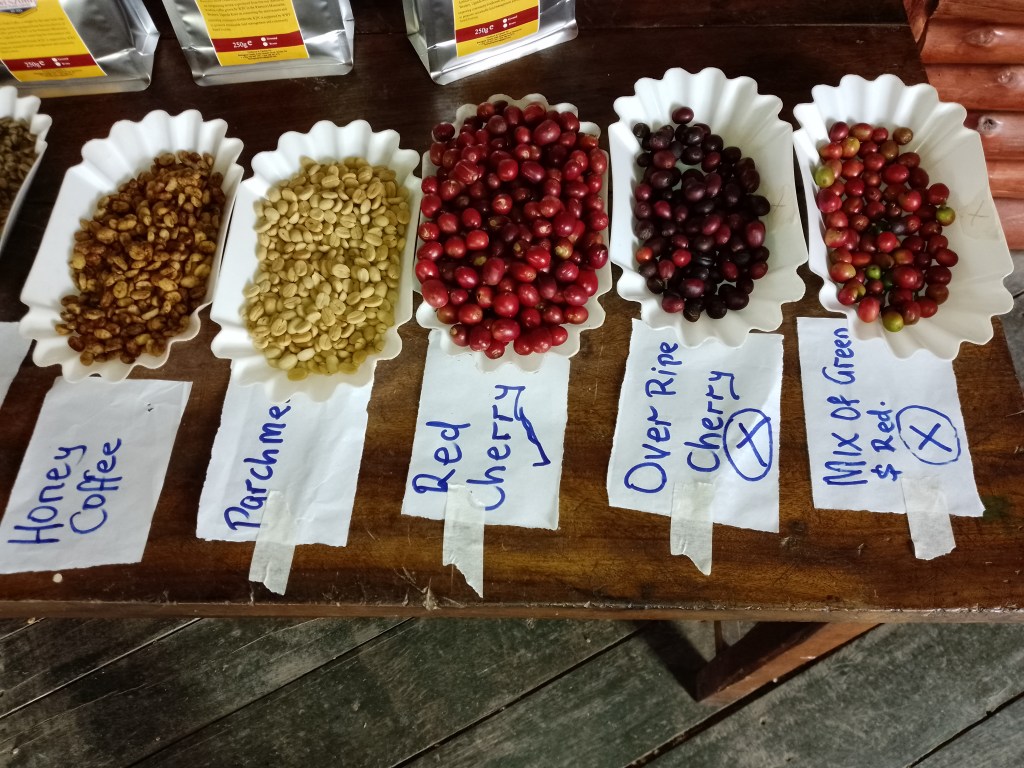
While a kilogram of coffee beans earns about Shs2000 or less, at the Coffee House, each kilogram of value-added coffee goes at Shs20, 000.
For officials of the park, this is a welcome gesture because it reduces the human-wildlife conflicts, and creates harmonious coexistence with the frontier communities, A 2021 synthesis report titled “Protecting East Africa’s Natural Capital: The Cost of Inaction” by the East African Community identifies land uses that convert natural vegetation as leading cause of land cover changes, increasing erosion and sedimentation, and reducing water flowing through the environment.
The report says this situation is likely to worsen in the future, with livestock numbers projected to increase in Uganda by 224% by 2050 under a business as usual scenario and that the likely outcomes are extirpation of iconic species like gorilla and iconic migrations like wildebeest due to habitat shrinkage and disappearance of connectivity.
The report recommends that establishing and promoting community-based natural resource management offers the most scalable avenue to ensure wildlife habitats are secured, dispersal areas and migration corridors are established, and wildlife afforded protection.
James Okware, the Senior Warden in charge of the Rwenzori Mountains National Park said the introduction of alternative livelihoods for the frontier communities has reduced pressure on the protected area which had been threatened by the increasing population pressure in the region. He said this had put more demand for forest resources, agricultural land leading to loss of biodiversity, landslides, soil erosion, and reduced water quality.
“We used to have issues with these communities because they were destroying our forests and the biodiversity of the part. UWA and WWF partnered with this community to develop a product which connects the communities with the park, and now the pressure on the national park is no more” he said.
Daniel Ndizihiwe, Wildlife and Protected Areas Manager at WWF Uganda said empowering the communities has helped in protection of the park from encroachment and destruction.
To him, most of the activities taking place in areas close to the park have an impact on the conservation efforts and that it is very important to collaborate and work with the neighbouring communities.
“Promoting sustainable coffee farming using sustainable land management systems contributes to protected area management because, the buffer isn’t destroyed and the farmers will benefit because they will be getting money from their coffee,” he said.
Abandoning poaching for sustainable livelihoods At Queen Elizabeth National Park, a group of former poachers have vowed never to go back to the old, dangerous poaching that claim several lives of their relatives. For years, men in Kabukwiri village, Ndagare parish, Rubirizi district were on constant collusion with the officials of Uganda Wildlife Authority because of poaching. Many of them were arrested and imprisoned while others were eaten by the wildlife in the park.
This caused agonies to many women who were left widows at tender age because their men were either killed by wildlife, or died in exchange of fire with wildlife rangers at Queen Elizabeth National Park.
Provia Katushabe is one such woman who was raised by a poacher and married a poacher. She said while growing up, her father would hardly spend days at home because he used to raid the park for wildlife poaching. As children, they did not get to spend enough time with their father because he would either be on the run escaping arrests, or in the bush poaching.
Katushabe said after growing up, she got married to another poacher and the misery that she thought she had left at her father’s house continued into her marriage life.
According to her, the husband was a menace because every time he conflicted with the law because of poaching. She said her husband was arrested and imprisoned several times and at one time, the entire family assets were sold off to bail out the man who had had constant conflicts with the law. Katushabe said this was the lowest point of her life and she did not know which direction the marriage was heading, with the future bleak for the family.
“We would be in constant fear because whatever meat they brought, we had to eat it all, wash the utensils and bath the children so that the smell does not betray you. So when I got married I thought I had escaped from that kind of life, but unfortunately I married another poacher. It was a stressful life because my husband would come home with game meat and UWA rangers would apprehend him. At one point when he was arrested, we sold our land and other assets to get him released. So we started life from zero,” he said.
Just like her, several other women had suffered because of poaching by their husbands. Many were widowed because they lost their husbands while poaching. Time came and the widows decided that they had had enough of the troubles with the law and needed to act now or perish in abject misery.
In 2018, the men from Kabukwiri with pressure and encouragement from their wives denounced poaching, marking a new lease of life for the entire community. Under Kabukwiri Reformed Poachers, the community started engaging in tree planting, apiary and a number of other income generating activities that transformed their lives.
Saturday Valentine, the coordinator of the ex-poacher said the group since abandoning poaching, they have had stabilities in their families and are progressively moving forward. He said through the nature capital tourism they are spearheading a campaign to stop poaching.
“From the time we abandoned poaching in 2018, our lives have changed. We did not value our children’s education, but we are now able to send our children to some of the best schools here and even in the other parts of the country. If you move in this village, there are no grass thatched houses because we are now able to earn and build good houses,” he said.
Women earning from Apiary
In 2019, The National Forest Authority (NFA) signed a memorandum of understanding with the local communities, allowing them to plant over 600 acres of trees in Kalinzu central forest reserve. While the men planted the trees, women started apiary project in the forest reserve and are now earning big from it.
Alice Tugume, a member of the reformed poachers group said they had financial challenges and when they sat down, they agreed that the only way they would solve the problem would be by forming savings group.
With formation of Kabukwiri Apiary Women’s Project, the women started processing their honey, with a kilogram of honey selling as high as Shs25,000, Sande said life has never been the same.
“We no longer have the financial burden we used to have. We now run our families together with our husbands who are all involved in income generating activities. We no longer depend on our husbands, but we support them and now we can afford to take our children to good schools,” she said.
Clair Sunday, another member of the women’s apiary group said they are progressively getting more income from the apiary. The group now processes its own honey into finished products and supply the honey to local supermarkets and other customers.
“We harvest honey twice a year and earn up to Shs81 million from it. This has helped us to plan for our families and engage in other business venture, so we now say no to poaching. Those who still harbor interest in poaching should stop and come and learn good practices from us so that together we can conserve our wildlife for generations to see,” she said.
Scaling the programme across East Africa Caroline, the communications and membership manager for IUCN Eastern and Southern Africa said the approach used by Uganda Wildlife Authority to work with the local community has had a positive impact in conserving the natural resources and the wildlife and that such efforts must be integrated at the East African Community level.
“I was amazed by how Uganda Wildlife Authority has allocated land for the communities within Nyamamu Queen Elizabeth National Park. These people have denounced poaching and are engaging in income generating activities and restoration of lost forest cover. This is something that needs to be emulated across the region. There is also need for multi stakeholder engagement in addressing the issues of conservation of the natural capital across the region,” she said.
She said they are working with the East African Community and other partners to ensure that conservation takes route and the frontier communities are empowered so that they see the value in protecting the biodiversity and benefit from it.
Nyamamu said the wealth of East Africa is in its natural resources that cut across national boundaries, from the vast landscapes, iconic wildlife species, water catchment areas, arable lands, minerals and so much more. She said these resources are an important source of economic revenue and critical to East Africa’s economic growth.
“The region’s nature-based tourism industry, which is almost entirely dependent on wildlife and protected areas, contributes 7.5-10% of Gross Domestic Product (GDP) to the region which is the total value of goods produced and services provided annually. Communities in the East African countries especially those who live in and around natural resource rich ecosystems depend on the natural capital for their livelihoods,” she said.
 Africa Planet Watch
Leave a comment