
By Ezaruku Draku Franklin
draku@africaplanetwatch.org
BUSHENYI – A Ugandan entrepreneur has found a new use for water hyacinth, turning the water weed into nutritious animal feeds and organic fertilisers.
Uganda has struggled to contain water hyacinth on Lake Victoria since 1989 when the water weed first invaded the lake and by 1998, had attained peak coverage of approximately 2 000 hectares in the Ugandan waters of the lake. Fishermen and water transport users have been severely hit by the invasion in the past because it inhibits fishing and water transportation.
While all this has been happening, Eng. Justus Sande, the proprietor and the Managing Director of JUMOL AGROTECH Services Limited in Bushenyi District, has found gold mine in the dreaded water hyacinth by converting it into organic manure and animal feeds.
For some time, River Rwizi in Western Uganda has been choking on the water week until Sande got a solution. The former National Agricultural Advisory Services employee says water hyacinth is very rich in nutrients which it accumulates from the water bodies and therefore provides high nutrients for both animal feeds and organic fertilisers.
“You know where they grow, the places are very fertile because a lot of nutrients are drained into the water which these water hyacinths depend on and therefore they are very rich in these nutrients. So what we do here is that, we harvest them from the river and come and mix them with other organic products and make a very good fertilisers and animal feeds which are very nutritious,” Sande said.
He says after working with the government for so many years until he retired, he has embarked on providing inputs for farmers at a cheaper cost after value addition.
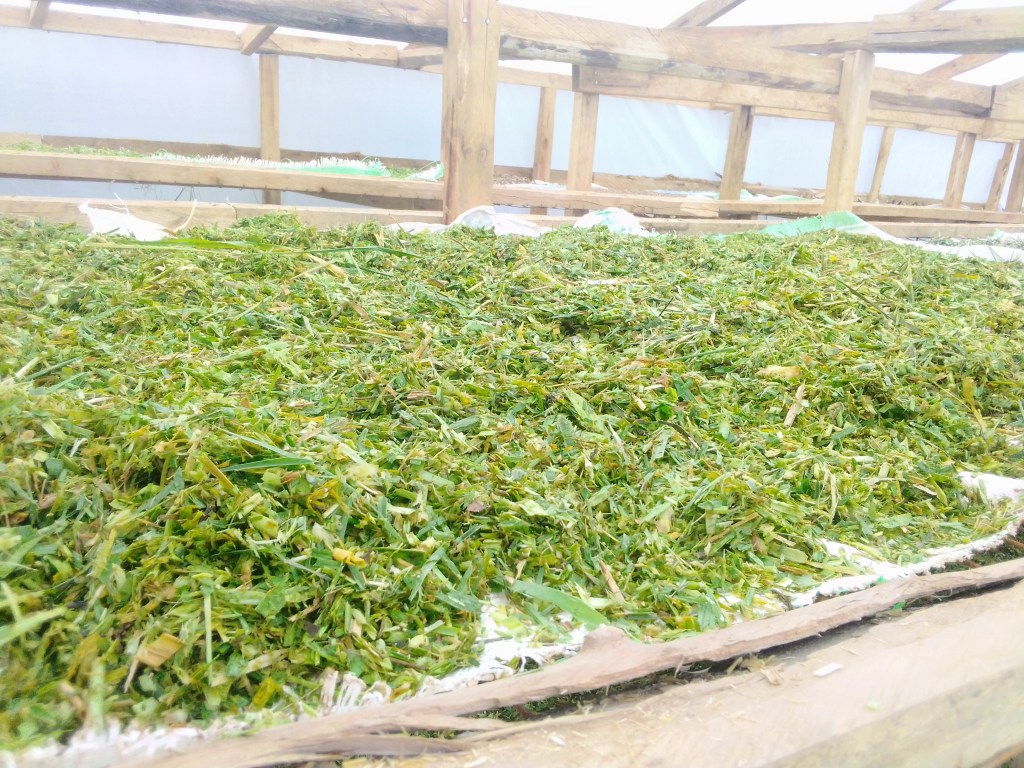
“Here we add value to pastures and soft grass, we blend them to give the correct formulae which would be vital for young animals and birds. One mistake people make is feeding these calves on natural hard grass and you expect them to do very well. We have carried out research and found out that a lot of people do not know this so here we also train them and then give them these feeds at cheaper costs,” he says.
He says water hyacinth produces pathogen-free rich compost which increases soil fertility, thereby improving the soil due to its low and narrow margin carbon with a lignin content of only 9 percent. He also says its roots can absorb plant nutrients and keep them into its trunks and leaves, which improves the physical properties of soil, soil structure, ventilates the soil, and makes it easy for water percolation.
“Many people cultivate around water bodies and all the nutrients end on the lakes and rivers. Water hyacinth grows where there is rich nutrients and absorbs all these and is very rich in these nutrients. When humus is moving into these rivers it is captured by the roots of water hyacinth. It only grows in an area where is getting daily fresh nutrients and the nutrients it picks from the water, it is what it stores within its body system and it is from it that where we get it, process it as you see in the machines. After milling it together with other pastures, we dry it and come up with the powder. Then at that level, we mix formulate it according to a particular purpose,” he says
Innovation wins more funding
Late last year, the Dutch Fund for Climate and Development (DFCD) through the World Wide Fund for Nature Uganda Country Office (WWF-UCO) received a grant of €38000 (Shs150 million) to support JUMOL AGROTECH Services to carry out feasibility and establish a sustainable stock, feed and mature formulation.
Part of the funding is for the study of the market trends and financial projections, stakeholder engagement, and to develop a light Environmental and Social Impact Assessment (ESIA) report.
Under the bankable projects, Sande said while providing nutrients to animals and for crop production, Eng. Sande using the water hyacinth also helps to clean the water bodies to conserve the natural ecosystems and biodiversity in the water bodies.
“You know water hyacinth has been a problem for this country and it has affected many water bodies, but now we have found a solution to it. If the demand increases and what we get from River Rwizi is not enough, we shall extend it to Lake Victoria and other water bodies. Through this we shall clean the water bodies and make them clean for both human consumption and other activities,” he said.
The company employs 20 people in different stages of production. The company mainly supplies its products to local farmers in Western Uganda with up to 50 constant farmers. At least 30 others have also enrolled for pig feeds and organic manure but some still protest the price.
“A product mixed with fish, maize grain, and molasses is sold at UGX 3000 per kilogram, but some people want to buy it at UGX700 comparing it with maize brand which is sold at UGX700,” he says adding that a lot of sensitization is still needed.
Sande however says while they hope to make costs cheaper, they are being hampered high costs of electricity and irregular supplies that affect production.
“The electricity is very expensive, there is when we have big orders and we are shut down. At times it comes when it is in a single phase for people who use it for lighting but not for industrialists to work,”
Harold Turinawe, the World Wide Fund for Nature Forest Markets Transformation Manager and Manager DFCD project in Uganda said the projects that have received funding from DFCD are those whose projects have business value and conserve environment. He said through such funding, they hope to reduce vegetation destruction and reduce carbon emission into the atmosphere, thereby reducing global warming.
He said Uganda is following a low carbon development pathway and has resilient forest landscapes, wildlife populations, and freshwater ecosystems that support biodiversity and socio-economic transformation of communities.
“We need to work with companies, financial institutions, and local stakeholders to develop Bankable Nature Solutions (BNS). This way, we can deliver impacts that reduce pressure on ecosystems, drive resilience and sustainability for both people and nature, while generating positive financial returns for communities and investors.”
Water hyacinth problem in Uganda
Water hyacinth, Eichhomia crassipes a waterweed native to South America, invaded Uganda starting from Lake Kyoga in 1988, Lake Victoria in 1989 and spread to the Upper and Lower Victoria Nile and Lake Albert. By 1994 the weed was covering 60% (570 ha) of the shoreline length of Lake Kyoga and 80% (500 ha) of the length of the Upper and Lower Victoria Nile.
Stationary fringes of water hyacinth covered 80% (2,200 ha) of the shoreline length of the Ugandan portion of Lake Victoria by 1995 and mobile masses covered about 1800 ha by 1998. Overall, water hyacinth cover over Lake Victoria at the climax of the infestation in 1998 was 12,000 ha (4000 ha in Uganda, 2000 ha in Tanzania, and 6000 ha in Kenya).
In Uganda, water hyacinth disrupted hydro-power generation at Nalubaale dam in Jinja, obstructed water transport routes especially docking of railway wagon ferries at Port Bell, prevented or delayed landing of boats, disrupted business at lakeside recreational centers, fouled water abstraction points and facilities, disrupted fishing and fish marketing activities, caused deterioration in water quality, reduced inshore spawning habitats for fish, impacted biodiversity, and increased risks of health hazards.
Figures from ministry water and environment and those from agriculture, animal industry and fisheries indicated that by 1998 at the peak of invasion, there was an estimated loss of Shs6.4 billion in 2 years at three landing sites of Masese, Gaba and Kasenyi.
This was due to closure of the landing sites that no fishermen could land and Shs233 million was the estimated monetary value of nets lost. The nets were drifted by the floating (mobile) water hyacinth as it was in transit and some were broken into pieces that they could not be used any more. There was also an additional cost of about Shs7.5 million due to fuel increase per fishing trip. The fishermen had to break through floating mats of the hyacinth especially that were usually encountered in the open waters of Lake. Victoria. The delays in landing often led to fish spoilage.
 Africa Planet Watch
Leave a comment