
By Ezaruku Draku Franklin
The society should stop framing men as perpetrators of sexual gender based violence, but must be included in planning for interventions that aim to prevent sexual gender based violence, a group of civil society organisations have demanded.
While men die silently under the weight of violence, different studies have majorly focused on the impact of SGBV on women, while the former are framed as the sole perpetrators of such violence, which, the CSOs said is wrong.
“We recommend the full inclusion of men and boys in gender-based violence (GBV) prevention programming from the project design to implementation and evaluation. We reject framing men solely as perpetrators; instead, promote their role as allies and partners in gender justice work,” a conference resolution at the end of the three days event states, adding that “government and other partners should create safe spaces for men to reconstruct positive identities.”
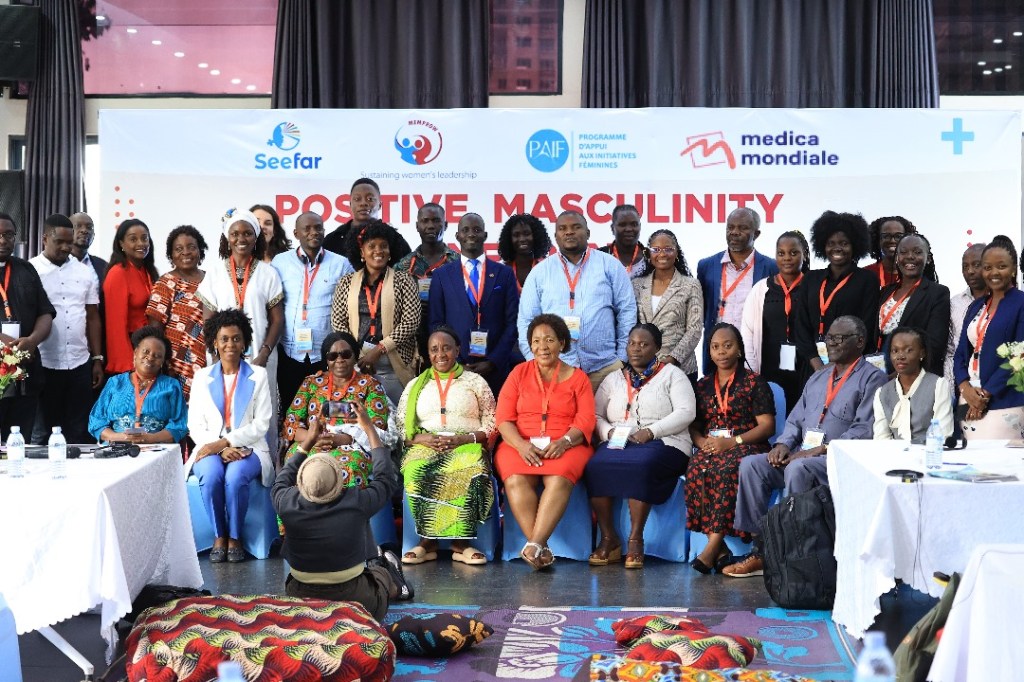
Organised by the Mentoring and Empowerment Program for Young Women (MEMPROW), a feminist organization working to promote the rights of women and girls, in partnership with PAIF and Medica Mondiale under the See Far project, participants agreed that there is urgent need to transform harmful gender norms and promote positive masculinities as a critical pathway to ending violence against women and girls and achieving gender equality.
The regional conference on positive masculinity that drew in participants from Uganda, the Democratic Republic of Congo, Rwanda, Burundi and Germany, said men play a crucial role in fighting against SGBV and that many times they are often left out when planning for interventions.
“We resolved to commit to demystifying harmful myths and misconceptions about masculinity, call for early mentorship of boys to nurture values of empathy, care, accountability, and non-violence and encourage integration of positive masculinity content into formal and informal education systems and in the community,” they said.
Data on SGBV
A 2021 Uganda Bureau of Statistics report found that 95% of women and girls have experienced some form of violence including physical, sexual, emotional, or economic violence.
The report said there has been reductions in women’s experience of both physical and sexual violence from 56% in 2016 to 44% in 2022; and significant reductions in men’s experience of domestic violence from 44% in 2016 to 34% in 2022.
The report however said women’s experience of domestic or intimate partner violence remains unacceptably high, overall stagnating at 58%, and increasing from 39% in 2016 to 43% in 2022 of ever partnered women experiencing domestic violence in the 12 months preceding the survey. Similar to the global figures, 49% of women in Uganda report experiencing online violence and harassment.
The participants said more should be done to promote women’s economic and social empowerment, which contributes to the well-being of families and communities.
“We advocate for increased investment in women and girls’ empowerment for voice, choice and agency. Advocate for reforms in laws and customary practices that uphold male privilege, such as those related to land ownership, property rights, inheritance, and polygamy. Call for gender transformative policies that promote accountability, justice, and equality,” the resolution said.
Reverend Nathan Mugalu, a National Medal Champion and one of the advocates for gender equality said as partners in the fight against gender-based violence, the fight against teenage pregnancies, but also in the fight against all injustices against women, girls, and the entire community should not be a one sided programme, but an inclusive one brings everyone on board.
“Because men are actually partners, we are bringing men on board, not as perpetrators, or not as criminals, but we are bringing them on board as partners and as part of the ecosystem where we can mobilize men to take lead in their communities in the protection and safeguarding of our children, where we rallying men to take lead in their communities in the fight against gender-based violence of all sorts, especially against women and girls,” he said.
Take on mentorship roles
Rev Mugalu said men must take lead in mentoring the younger generation who are currently battling a lot of issues including drug and substance abuses, social ills in the society and mental health. He said by taking lead, they want to nurture the next crop of men who will step into their responsibilities.
“But also we are rallying men and see how men can take lead in the mentorship of the young boys, because the young boys are part of the future and the today that we are building. We are rallying men to respond to the health needs, but especially in maternal and child health. Rallying men to participate in their leadership where they come from, but also rallying men to help us deal with the issues of drug and substance abuse from where they come from,” he said.
Immaculate Mukasa, the Executive Director of MEMPRO through networking, there is need to share the best practices on the nurturing and building positive relationships. She said the nurturing of responsible citizens starts when parents take responsibility of mentoring the young ones from tender age, to adulthood.
“From the time we have children as parents, how do we nurture them to be supportive to each other, to be human beings and express their humanity in a way that advances us as a community, as a nation, as a region, the Great Lakes region,” she said, adding that if this happens, then we’ll have girls, women, boys and men benefit from a safe environment, gender-just environment where they can all thrive and develop together.”
She said it’s important to acknowledge that the masculinity has changed and they keep changing and said decision making cannot only be a preserve for the men.
“Today we have technology, everybody can access a gadget and get information. So saying that a man can only be a decision maker, when they are not a decision maker, who are they at that point? When they are not providers, who are they at that point?” she questioned and said that “saying that a man is not supposed to express their emotions is also wrong. It does not help our boys to be who they are as humans.”
“It limits their access to services that are most of the time available to them. The health services, psychosocial support services, all services where they can get emotional support. It’s important to allow them to act in their humanity and that leadership can be shared, power can be shared, and we can all be contributors to our society for a diverse need,” she added.
She said help should not be available to girls and that boys’ too like girls have emotions and needs that must be addressed, whether at cultural level, or at school or within the societies.
“The reality is that things are changing. We have to face this reality and it’s important to share roles, it’s important to share responsibilities, it’s important to acknowledge our humanity as a people. It’s important that we take on these changes and share the realities today. So if you are in a school and you are a teacher, it’s important to acknowledge the boys need help, need support,” she said.
“The importance of is not only for girls, it’s for boys as well that the boys are encouraged to open up instead of hiding and then you hear cases of suicide. It’s important that they are given an opportunity and they know that they are supposed to speak about how they are suffering in school, to express their emotional needs and to be encouraged to participate in all activities,” she added.
Dr. Mary Ssonko, an associate professor of development studies at Uganda Christina University said, while owmen are progressively taking leadership, the changes in the economy and the past political upheavals the country went through created a situation where many men lost the role of being providers in their families.
“The challenge is also, we also have now some absentee fathers, so the burden of the house falling deeply on the woman, even within homes where we have partners, or spouses. And that presents a complicated picture and leading us to reflect on positive masculinity. How do we ensure that men keep present and they are present in real terms in the real time? Because I think that’s the challenge we are having, the absence of men in real time, either to provide for their children to be available for others, for their children, for their spouses. And I think that’s what we are asking for from a positive masculinity point of view,” she said.
She also said the fact that things like Covid-19, HIV, he wars in the past and the structural adjustments in the 1990s all affected men and eroded their economic powers and the ability to be the providers and protectors forcing many to remain idle.
“In the context of probably not being able to provide for your household, another person may come into practice as a decision maker. Either by supporting your wife’s economic status, these issues have implications on you feeling your position as a man in that house and welcoming these people who are coming in to use the guardian of the women. There are various factors at that level that we need to reflect upon that have implications on the position of the man in that household,” she said.


 Africa Planet Watch
Leave a comment