
By our reporter
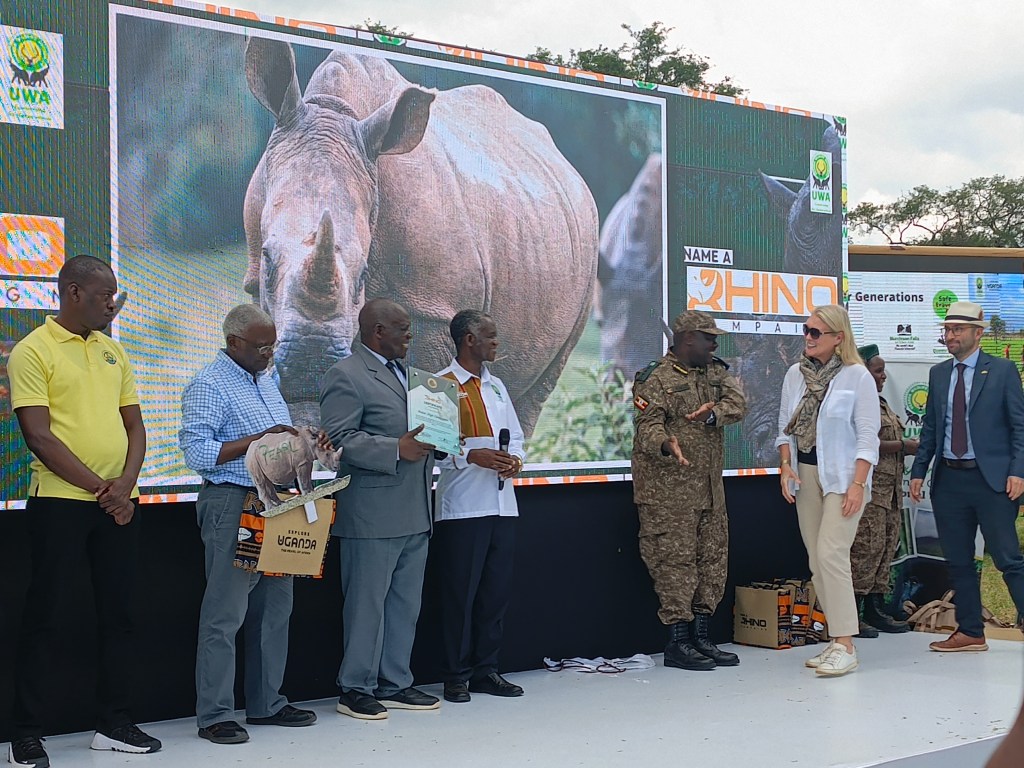
Ziwa Rhino Sanctuary in Nakasongola district was a site of merry-making as Uganda celebrated the International Rhino Conservation day with naming of 17 juveniles born at the sanctuary.
For the conservationists, the function represented resilience and teamwork in conservation efforts after the last eastern black rhino was gunned down 42 years ago at Kidepo Valley National Park in Karamoja sub region.
The event graced by Muruli Mukasa, the minister of public who represented president Museveni saw several conservationists, tourism sector players, private sector and several others converging together to celebrate the success of reintroduction and breeding of rhinos in Uganda from the initial six to now a total of 50 rhinos.
James Musinguzi, the Executive Director of Uganda Wildlife Authority, the government conservation agency charged with protecting and conserving wildlife in the country, said this is an irreversible journey of the rhino conservation that will also see the eastern black rhinos reintroduced.
“Today we reflect on our past with humility and look to the future with new pride. Uganda once flourished with rhinos, but by 1983, they have vanished from our national parks,” he said.
42 years ago, the country’s final eastern black rhino was gunned down at Kidepo Valley National Park, marking the final blow to the existence of both the northern white rhino and eastern black rhino sub species that had roamed freely across the country.
However, the reintroduction of the southern white rhinos in 2001, with the first two of the rhinos kept at Uganda Wildlife Education Conservation Centre at Entebbe.
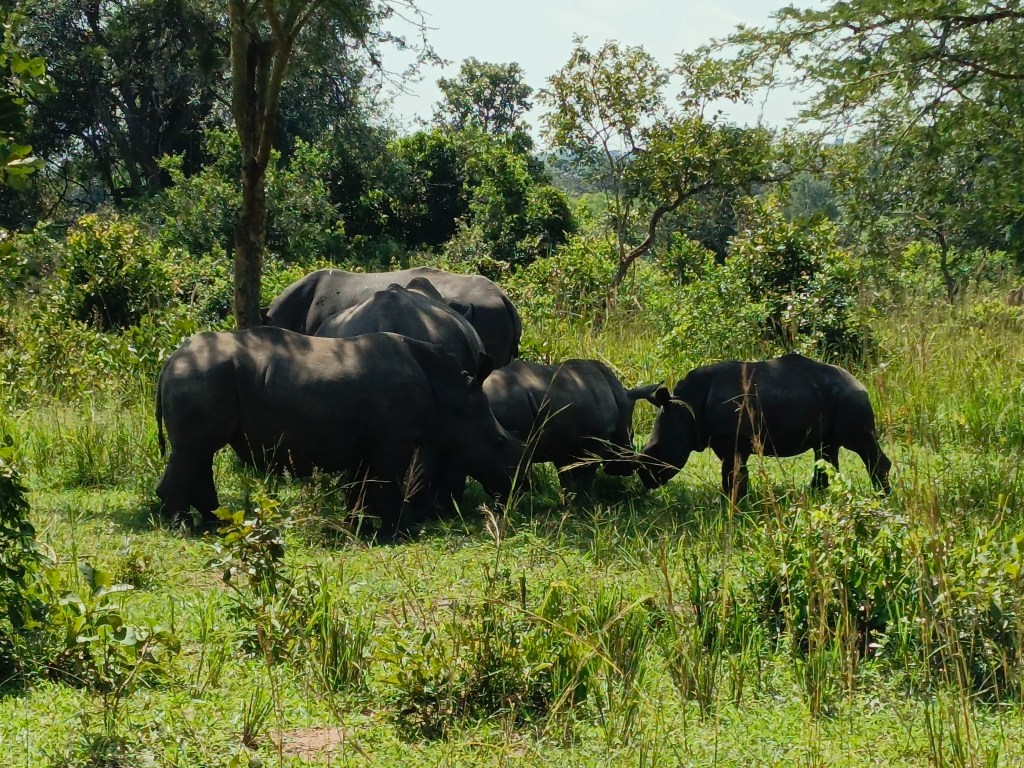
These were followed by six others between 2005 and 2006 and were taken to Ziwa Rhino Sanctuary, a 72 squarer kilometer sanctuary that has since birthed up to 46 calves.
“The naming of 17 rhinos today is more than statistics. It is a powerful statement that Uganda has chosen restoration over despair and resilience over loss. At this point, I wish to pay tribute to all those who first worked hard and pursued the dream of bringing back the rhinos to Uganda,” Musinguzi said and added that “their foresight and persistence laid the foundation upon which we now stand.”
Musinguzi paid tribute to those who financed the arrival of the first rhinos for the zoos in US and Kenya, including Sudhir Ruparelia, Sheraton Kampala, and several others that financed and importation of the rhinos into the country.
“People like Dr Sudhri Ruparelia, under the Kabira Country Club, Sheraton Hotel and others were some of the people who gathered money to bring back the rhinos. USAID also supported these when we were getting the rhinos from the Soryo Ranch in Kenya and USA. We appreciate the support of Rhino Fund under the stewardship of Ms. Angy Genada for the dedication and care and protection,” he said.
“The naming of 17 rhinos today is more than statistics. It is a powerful statement that Uganda has chosen restoration over despair and resilience over loss. At this point, I wish to pay tribute to all those who first worked hard and pursued the dream of bringing back the rhinos to Uganda,” Musinguzi said and added that “their foresight and persistence laid the foundation upon which we now stand.” Dr James Musinguzi, Executive Director, Uganda Wildlife Authority.
He said conservation is not only about saving wild animals, but about safeguarding livelihoods, jobs, and the futures of the frontier communities.
“Every rhino here attracts visitors, generates employment, jobs and the future. Every rhino generates employment and sustains local enterprises as well as reinforcing Uganda’s global reputation as a premier wildlife destination. Behind each rhino are farmers supplying food, guides sharing our stories, transporters serving tours and countless Ugandans whose lives are uplifted by conservation driven tourism,” he said.
Dr Musinguzi said under the 10 year rhino conservation strategy, the authority plans to translocate the white rhinos to other parks, starting with Ajai Wildlife Reserve where 20 rhinos will be taken by the end of the year, Kadepo Valley National Park where work has already started to prepare the area to receive both the white and black rhinos and Murchison Falls National Park where the rhinos also thrived before.
“After taking it to Ajai, we are working hard with some partners, the Northern Range Trust, to introduce 100 of them. Not out of these, but they’re going to be imported into Kidepo Valley National Park and work has started there. We are also going to come to Murchison Falls National Park. And at the moment, we are dealing with the Southern white rhinos. And we are also going to bring back the indigenous Eastern black rhino. And all of this is a systematic approach that has been developed and documented within a 10-year rhino conservation strategy,” he said.
Juliana Kagwa, the Chief Executive Officer of Uganda Tourism Board said as a government entity, they cannot ignore the fact that for them to market the country, they need to have the products readily available
“So the work we’re doing here today and the work that we have partnered with Uganda Wildlife Authority to do is to conserve and protect our product. We need to increase the stock or the product of what we are offering in tourism. So we cannot promote what we don’t have. We cannot sell what doesn’t exist. So when you see us here in the bushes, tracking the rhinos. It’s not about content creation. We are actually working to promote a sustainable tourism product,” she said.
Kagwa also urged all Ugandans to take responsibilities in protecting the country’s biodiversity for future generations. She said it is through working together that the country can protect its wildlife resources.
“So these animals, they belong to all of us. And nowhere else have I seen a sustainable ecosystem where human and wildlife are humans and wildlife are existing, coexisting so comfortably than here at Ziwa. This is exactly what we need to replicate at Ajai and all the other locations that we’re going to be translocating our rhinos to,” she said.
Ms Lisa Chesney, the British High Commissioner to Uganda who, ahead of the world rhino day and the naming ceremony had led a campaign to rally diplomatic missions accredited to Uganda to join the conservation efforts said Uganda has shown to the rest of the world that they are truly the champions of conservation, by successfully reintroducing the white rhinos and multiplying the numbers.
“Uganda has something incredibly special. Your biodiversity is your superpower. You have got half of the Africa’s bird species, over 40 % of the mammal species. For those of you that have said, why would you not take your sunglasses off? I got up close and personal with some of your insects at the weekend. But they’re all part of the biodiversity too,” she said.
Ms Chesney last week hosted the diplomats and other dignitaries for a dinner at her residence in Nakasero where she urged them to join the rhino naming and conservation efforts. At Ziwa, she also said nature and wildlife is under threat, not only in Uganda, but across the world and therefore everyone must make contribution in supporting the conservation efforts.
“Poaching, climate change, under investment,” she said are driving the wildlife species to extinction and therefore the UK government cannot just sit by and watch what is happening.
She said UK has been a long time partner in Uganda’s development journey and that tourism and conservation play a big part in generating revenue for the country. She said her government back home takes keen interest in supporting Uganda’s development agenda.
“We care about Uganda’s ongoing development and thriving with friends and with partners. You’ve heard this from every speaker, the T in the ATMs, the tourism part, is a really critical part of that 10-fold growth strategy. And it’s fantastic to see public and private sector here and activists and NGOs in the conservation space. The UK is one of the top three leisure markets for tourism. I’d like even more tourists to come here,” said, adding that “we support infrastructure, such as the Kabalega airport, or some of the roads, studies, round tables with tour operators, and much more.”
“We’re supporters of nature and biodiversity for about the last 30 odd years with the Darwin Initiative and the Illegal Wildlife Trade Challenge Fund. And also we focus on climate resilience,” she said.
Cultural perspective
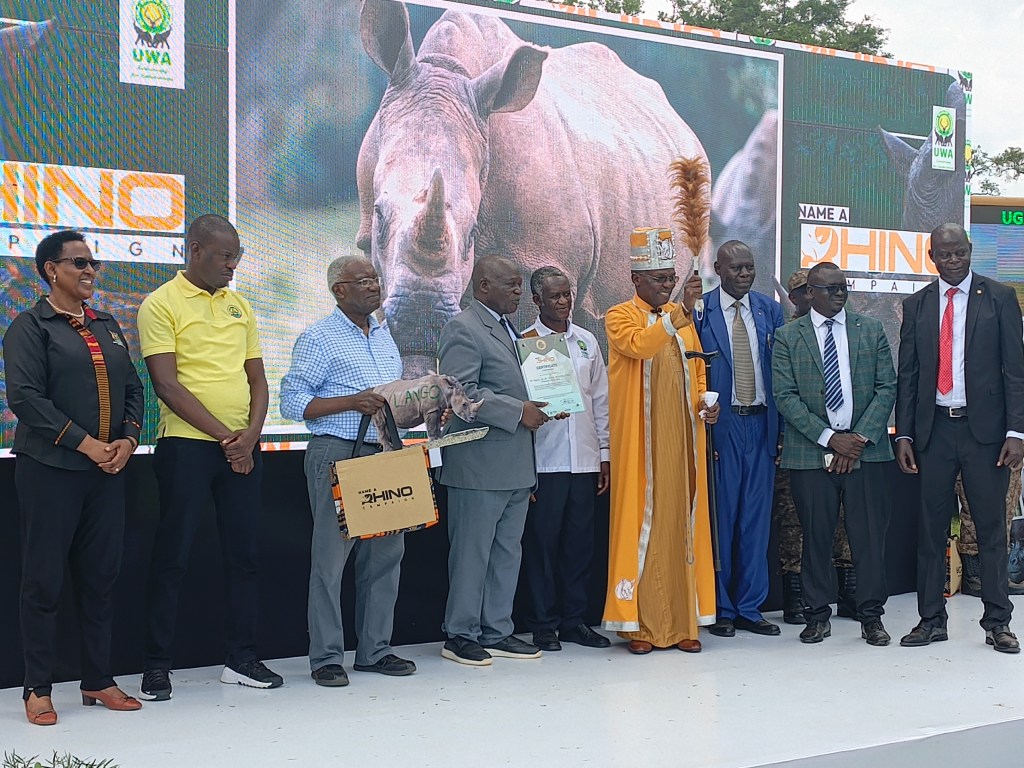
The Lango Paramount Chief, Dr Michael Moses Odongo Okune, said the people of Lango attach a huge cultural attachment to the rhinos and therefore their reintroduction is a positive step in the right direction.
Dr Odongo also named one of the Rhinos Lango and said this is because the rhinos are their cultural sacred symbols.
“I have come because Amuka (rhino) carries great symbolism in my community. And we are proud to associate with this conservation effort. Amuka is a symbolic animal in my community. Amuka is our cultural symbol. And it’s an animal which carries, and has given names to many items in our community,” he said.
He warned poachers and wildlife traffickers to take their hands off the rhinos and said as a cultural leader, he will do anything to protect the animals.
“So that our Amuka almost went extinct was not good for our culture. And the people who are poaching and killing these animals were in the mistaken belief that the horn contains aphrodisiac. I am a scientist myself, science has not yet supported that there’s any chemical in the rhino horn that can improve your sexual performance for you men. Your sexual problems are not solved by rhino horn. You go drinking beer, then belching for people, eating pork, you don’t do exercise and then you go killing a rhino that you’re going to improve your sexual performance. Look for solutions to your sexual problems somewhere else, not in the rhinos,” he warned.
Yogi Birigwa, the president of Uganda Tourism Association said the success of rhino reintroduction and breeding in the country shows the resilience of Uganda’s conservationists in protecting the wildlife species.
“We are proud to say that Uganda is no longer a country of least rhinos, but one where the challenge is now having many rhinos with limited space to roam. The private sector has always been committed to this journey. From the very beginning, we have ensured that Uganda’s itineraries include visits to this sanctuary. Tour operators, guides and travel planners have brought tourists from all corners of the world to come and experience this conservation miracle,” she said.
Tom Butime, the minister of tourism, wildlife and antiquities said the naming of the rhinos marks a new chapter, from reintroduction to breeding which has seen the rise in the numbers.
“By 1980, rhinos had been completely wiped out of Uganda, driven to extinction, which was a loss for our pride, heritage and identity. It is therefore very important for us to celebrate from species extinction to reintroduction of six individuals and restoration of the current viable population. Our successful reign of conservation history is a result of hard work, resilience, strength and hope,” he said.
“The naming of the 17 young radios today symbolizes not only numbers, but Uganda’s determination to raise above adversity and secure our natural heritage. So it’s not just a ceremony, it’s a powerful statement of how far Uganda has gone. It’s a reminder of our painful past, a celebration of our concerted efforts, resilience and promise for the future,” he added.
Wilson Muruli Mukasa, the minister of public service, who represented president Museveni said government committed to promoting livelihoods and ensuring communities benefit directly from tourism. He said a comprehensive strategy is already in motion to position tourism as a key driver of economic growth, job creation, and national pride, all while safeguarding the environment for future generations.
“The NRM government has demonstrated full commitment to promoting livelihoods and community benefits through tourism. A comprehensive strategy has been rolled out to strengthen the sector. Together, these efforts are transforming tourism into a driver of economic growth, job creation, and national pride, while safeguarding the environment for future generations,” he said.
 Africa Planet Watch
Leave a comment