
By Our Reporter
The Uganda Wildlife Authority has finally taken over control of 8.86 tonnes of illegal wildlife products that were confiscated at Entebbe International Airport and held by Aviation Police for more than a decade.
The inventory exercise began on May 19, 2026 under the leadership of UWA Assistant Commissioner for Law Enforcement, Ms Margaret Kasumba.
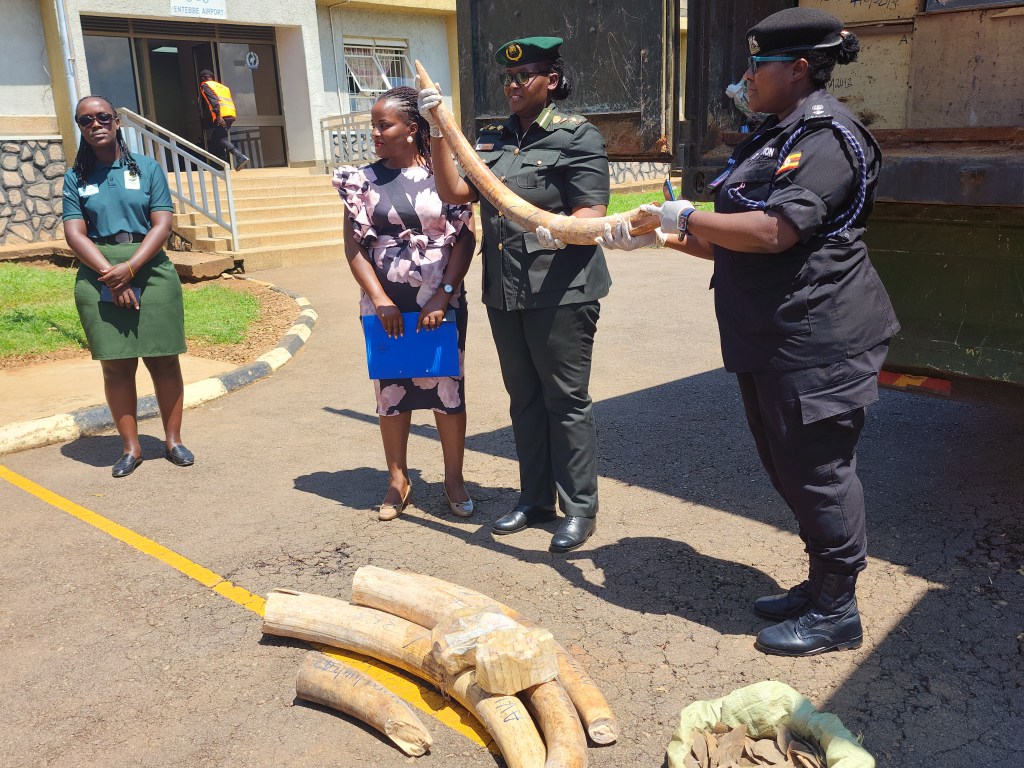
While handing over the exhibits to UWA at Aviation Police on Friday, the Superintendent of Police Irene Mugoya, who represented the Commandant of Aviation Police, said the exhibits were seized between 2011 and 2025 through joint operations with UWA and other security agencies.
“It is important to note that some of these items were concealed in tins labelled as shea butter in an attempt to evade detection, highlighting the sophistication of wildlife trafficking networks,” she said.
The Wildlife contraband that were handed over to the UWA include ivory, both raw and processed, pangolin scales, rhino horns, hippopotamus teeth and skins, lion teeth, and ostrich eggshells.
Mugoya said over the years, there has been a decline in wildlife trafficking through Entebbe International Airport which attributed to tighter security and intelligence at the airport.
“Due to strengthened security measures, including the deployment of the canine unit in 2018, no seizures of such magnitude have since been recorded at the airport,” she said.
For over a decade, the aviation police had held onto the contraband, and with time, they ran out of space to keep the confiscated wildlife products, forcing them to hand it over to the wildlife authority for safe custody.
“I extend my sincere appreciation to the Executive Director, UWA, for responding positively to our request to take over these exhibits, especially in light of the limited storage space at Aviation Police, where even designated facilities had to be repurposed for storage,” Mugoya said.
She commended the joint teams from UWA and the Police who conducted the inventory exercise and confirmed that all exhibits are intact and properly accounted for.
Ms Margaret Kasumba, Assistant Commissioner for Law Enforcement and Operations at UWA, who received the items on behalf of the Executive Director. James Musinguzi said the handover marked the conclusion of a long inventory exercise involving exhibits seized at the airport since 2011.
“We have received 8,857.84kg in total of confiscated wildlife products that were held at Aviation Police, Entebbe International Airport, for 14 years,” Kasumba said.
The stockpile quantity
Records presented to the wildlife authority indicates that 6421,64 kilogrammes of raw ivory in large pieces were confiscated, 275.53kg of processed ivory in smaller pieces, making a total of 6,697.17kg. Other items were 48 rhino horns weighing 111.75kg, and 1,980.2kg of pangolin scales, and 14 hippo teeth weighing 12.6kg.
Kasumba also said additional worked products include tortoise shells, warthog teeth, ostrich eggshells, waterbuck skulls, zebra and buffalo bones, assorted wild animal bones, crocodile skins made into belts, bags and sandals, crocodile teeth, assorted canine teeth, and pangolin claws.
“The total amount of all wildlife products handed over to UWA by Aviation Police is 8,857.84kg of everything handed over today,” she said.
Kasumba thanked Aviation Police for safeguarding the exhibits since 2011 and said the vigilance has helped in reducing wildlife trafficking.
“We started impounding at the airport and suspects being brought to this police station in 2011. To date, what has been confiscated is what I’ve just read. We thank Aviation Police specifically because whatever has been kept here for 14 years, from 2011 to date, has been recovered intact,” she said
UWA verified the consignment using a digital wildlife products management system that stores photos, sizes and features of each exhibit. Kasumba said three inventories were conducted before the final handover.
“We took a lot of time here doing this because we wanted to be sure that whatever was kept here is actually there, so that we continue working together well. Our inventory system was able to indicate that whatever we kept here has been recovered,” she said.
“We continue to work together as a team of security personnel in Uganda to conserve our wildlife for generations,” she added.
On disposal, Kasumba said the law is clear. “Once we receive updates from police and courts on the status of these cases, we’ll know how to manage custody and determine the next steps.”
She explained that under contraband -CITES, the Convention on International Trade in Endangered Species of Wild Fauna and Flora, Appendix I species seized from illegal trade must be destroyed.
“Destruction is the only option for contraband obtained through illegal trade, and that decision is made at a level higher than mine,” she said.
CITES only allows trade for wildlife products obtained legally, such as from natural deaths or problem animal control, and only if a country’s population has recovered to a sustainable level. “For example, if our elephant populations in national parks exceeded carrying capacity, we could request permission to sell legally obtained products. But we are not saying that permission has been granted,” Kasumba said.


Leave a Reply